Monday, March 19, 2012

Scones, Fruit Salad, Toad in the Hole

This week, I don't think that the group did as well as it did in the past. We were a bit more unorganized than usual, and some people seemed to be a little testy. I'll attribute that to CSAPs. Other than that, though, we got the job done and the experience wasn't horrible. It just wasn't as smooth as before.
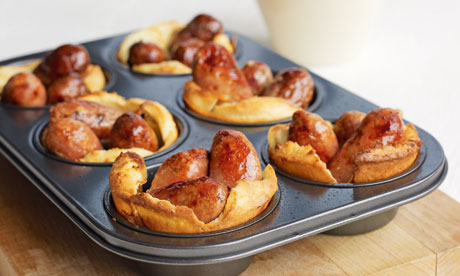
Well, our toad in the hole didn't look quite as it was supposed to since we have a vegetarian in our group- so we couldn't put the sausage in the batter like you are supposed to. However, compared to a regular pancake, it seemed to be much thicker and perhaps not as airy. It also bubbled a bit, sort of like the crust on a good pizza. That doesn't happen to most pancakes, but maybe that's because you don't usually bake pancakes in the oven like you do with toad in the hole. I didn't eat any because I wasn't hungry that day, but everyone in the group who had some said that it was very good. I've personally never been a fan of pancakes, but maybe I'd like this. I'll have to try it again sometime. I'm also not much of a "breakfast food" person in general (just yesterday I had lentil soup for breakfast, haha), so I can't say I have a very educated opinion on this food as a breakfast item.

Here is a link to a Toad in the Hole recipe, courtesy of the Food Network.


My group did not substitute milk for orange juice when making the scones, just saying. You could probably substitute milk with just about anything of a similar viscosity and texture, like other kinds of juices. You might even be able to substitute it with different kinds of coffee, and probably even with hot chocolate or something like it.

For our cantaloup salad, we tried to stack it a little bit. It had been cut into generally uniform squares, so we used that to our advantage. We placed a few leaves off to one side for some decoration, and Kady put a piece of cantaloup right in the middle of our seedless jalapeno pepper, hahaha. It looked pretty nice, overall. It could have been worse. It's not the way I would have plated it exactly, but with what we had available at the time it was alright. I'm not complaining.

I know I should say that I enjoyed meeting new people and making friends or something lame like that, but, I don't exactly feel that way. I like my kitchen group well enough, haha, that's it. I have enjoyed cooking, but I seem to get stuck doing a lot of the dirty stuff. I've learned some new recipes that I would very much like to try again. I've also made myself learn to love to do dishes, haha. I don't know what to tell you. I don't hate this class, but I don't usually look forward to it. But if it makes you feel any better, I don't look forward to any of my classes, hah. In general, though, I think that this class has made me a better cook. I don't get to cook a lot at home because my dad likes to pretend that he's good at it, so this has kept me in practice.

Tuesday, March 6, 2012

Guineafowl

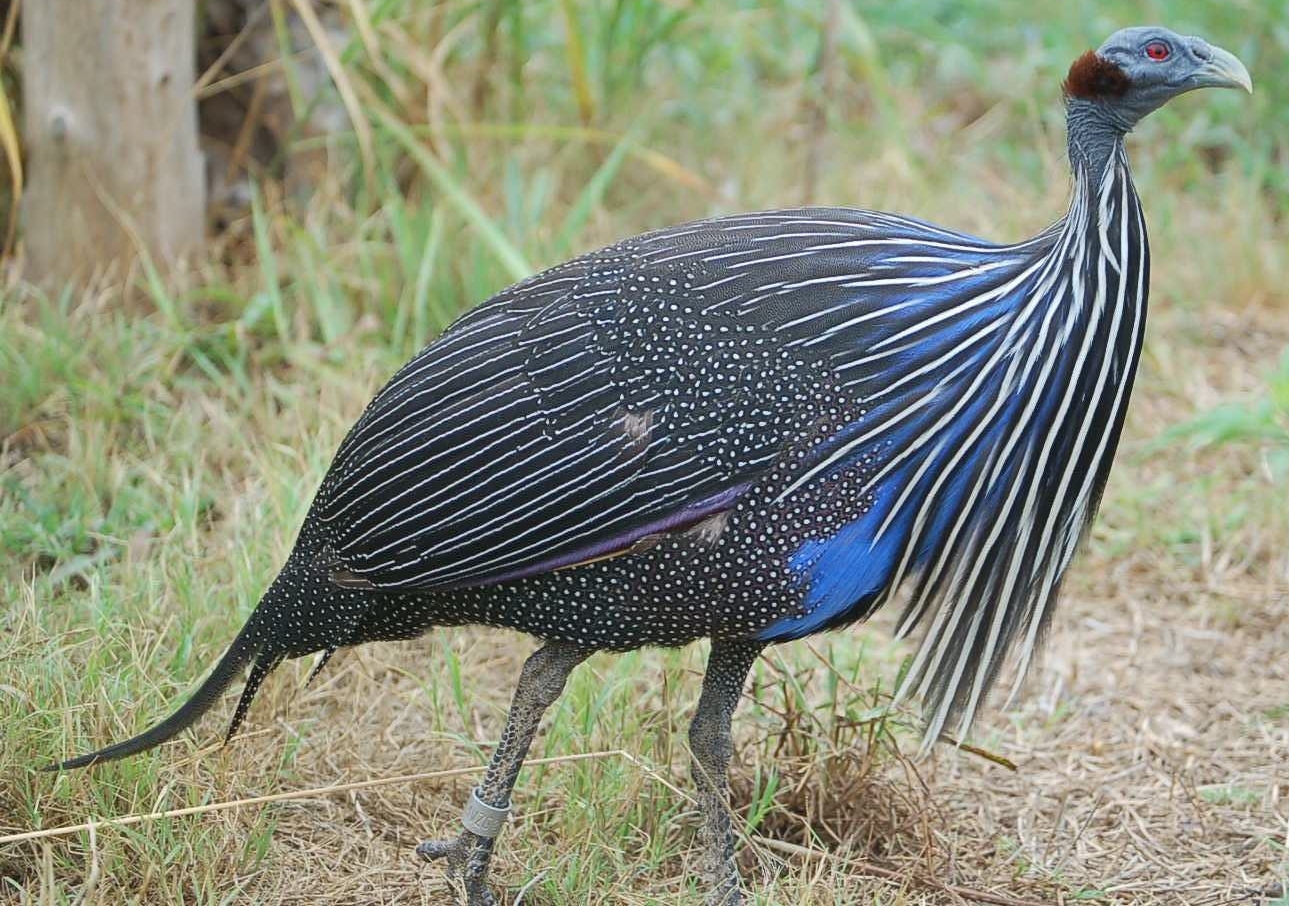
The guineafowl is a bird native to Africa, and is closely related to the chicken. There are several different kinds of guineafowl, and this bird has been a food item ever since the ancient Egyptians were around. 

Guineafowl can be a substitute for chicken and seems to be a very versatile meat which tastes good cooked simply or with heftier side dishes, like sausages and beans. Salads also compliment the bird well. I thought that this recipe sounded rather delicious. There is no one way to cook the guineafowl.  It is generally the "main course" of a meal. Its flavor is slightly gamey, but is much more subtle than pheasant and other wild birds.Their eggs can also be eaten just like chicken or goose eggs.

Because guineafowl is very similar to chicken, it can be cooked in just about every way that a chicken can. However, it also means that this bird can dry out if you don't cook it properly, so cooking it in a manner that helps preserve the moisture in it is most wise.

Since the guineafowl are a living thing, they are raised like chickens and other animals that humans eat. France, Belgium, and Italy are the largest produces of guineafowl. They can be raised free-range or in cages like chickens, but it is recommended that, when buying guineafowl, that you buy free-range guineafowl.While being raised they can eat generic commercial bird feed, or they can eat lice, worms, ants, spiders, and ticks if they are raised free-range.

The common guineafowl is (meleagris) named after a prince of Macedon in Greek mythology. Meleager, the prince, killed all of his uncles. He was then killed by his mother. For some strange reason, Meleager's sisters were turned into guinea-hens. As they cry, their tears form the pearl-shaped markings on the common guineafowl's face.

Here are two other recipes which can be used for cooking guineafowl.

Friday, March 2, 2012

Pie & Spaetzle

When you're making pie dough, it's important that you keep the dough as cold as possible and that you touch it as little as you can. If you want your pie to come out flaky, then it's also important that you leave pretty big pieces of butter in it for when it goes into the oven. In order to do this, you have to "cut" the butter into the dough, which means you cover it in flower and sort of stretch it out with your fingers into longer pieces. When the butter melts in the oven, it creates flakes because the butter is gone from the place where it was, and steam fills up those little pockets. When the pie crust comes out of the oven, it deflates like the cream puffs did, and then you've got your flakes.

This recipe can be found at allrecipes.com.

Ingredients

  • 1 1/4 cups all-purpose flour
  • 1/4 teaspoon salt
  • 1/2 cup butter, chilled and diced
  • 1/4 cup ice water

Directions

  1. In a large bowl, combine flour and salt. Cut in butter until mixture resembles coarse crumbs. Stir in water, a tablespoon at a time, until mixture forms a ball. Wrap in plastic and refrigerate for 4 hours or overnight.
  2. Roll dough out to fit a 9 inch pie plate. Place crust in pie plate. Press the dough evenly into the bottom and sides of the pie plate.


Spaetzle is are German dumplings. They're basically little bready noodles. If you make them too thick then they're no good to eat. You can add other things to spaetzle, like peppers and onions, cheese, etc. It doesn't  look too good, in my opinion, but it really just looks like a bunch of short and thickish noodles mixed in with whatever else you might have added to it. We shaped our spaetzle using a colander. If you pile the dough at the bottom of the colander and push it through into boiling water, then you've got your spaetzle! However, there are also more traditional spaetzle makers, and you can also make it using a knife and cutting board, but that's a pain in everyone's behind.

This recipe can also be found at allrecipes.com.

Ingredients

  • 1 cup all-purpose flour
  • 1/4 cup milk
  • 2 eggs
  • 1/2 teaspoon ground nutmeg
  • 1 pinch freshly ground white pepper
  • 1/2 teaspoon salt
  • 1 gallon hot water
  • 2 tablespoons butter
  • 2 tablespoons chopped fresh parsley

Directions

  1. Mix together flour, salt, white pepper, and nutmeg. Beat eggs well, and add alternately with the milk to the dry ingredients. Mix until smooth.
  2. Press dough through spaetzle maker, or a large holed sieve or metal grater.
  3. Drop a few at a time into simmering liquid. Cook 5 to 8 minutes. Drain well.
  4. Saute cooked spaetzle in butter or margarine. Sprinkle chopped fresh parsley on top, and serve.  
 
A galette is an old-fashioned pie with a hole in the top and all of the innards piled in the middle of it. I did not like or dislike it more than a regular apple pie. 
I think that my group is getting much more efficient. I am no longer the one always washing dishes, and I think the other girls are gradually becoming more considerate of me. This week, I don't have anything to complain about. Big surprise, right?